
If your Meta ad campaigns have felt unpredictable lately — winning ad sets suddenly tanking, interest-based targeting losing its edge, or creatives that used to crush it now barely breaking even — you’re not imagining things. A fundamental shift has taken place inside Meta’s advertising infrastructure. It’s called Andromeda, and it’s arguably the most significant overhaul of Meta’s ad delivery system since the introduction of Advantage+ campaigns in 2022.
This post breaks down exactly what the Meta Andromeda update is, why it matters, and what you need to do to adapt your ad strategy for the new era of AI-driven advertising.
What Is Meta Andromeda Update?
Meta Andromeda Update is the next-generation ad retrieval engine that powers how ads are selected and delivered across Facebook, Instagram, and Meta’s broader network. Announced by Meta’s engineering team in December 2024 and completing its global rollout by October 2025, Meta Andromeda Update replaces the older, more rule-based system that previously determined which ads even got considered for display.
Think of ad delivery as a multi-stage funnel. At the top sits a massive pool of millions of eligible ads. The retrieval stage is the first filter — it quickly narrows that enormous pool down to a shortlist of a few thousand potential candidates. From there, Meta’s ranking and auction systems pick the final ads a user actually sees.
Before Meta Andromeda Update , this retrieval stage was relatively limited. It relied on isolated model stages, manual rule-based heuristics, and constrained personalization — essentially asking: “Who should see this ad?” The system was slow to adopt AI innovation and struggled with the sheer scale of modern advertising.
Meta Andromeda Update changes the question entirely. Its like now asks: “Which ads should this person see ?”
The Technology Behind Andromeda
What makes Meta Andromeda Update technically remarkable is the hardware and software co-design at its core. The system runs on a combination of NVIDIA’s Grace Hopper Superchip and Meta’s own Meta Training and Inference Accelerator (MTIA) chips. This hardware setup allows Andromeda to process vast amounts of ad creative data and user behavioral signals in near real-time.
The AI advancements are equally impressive. Andromeda introduces a highly customized deep neural network architecture that achieves what Meta describes as a 10,000x increase in model capacity compared to its predecessor. This isn’t just incremental improvement — it’s a complete re-engineering of what was possible in the retrieval stage.
Before this upgrade, the retrieval system suffered from low hardware-level parallelism, memory bandwidth constraints, and limited ability to scale. Meta Andromeda Update solves all of these by designing the machine learning model, software infrastructure, and hardware acceleration as a unified system. The result is a retrieval engine that can scan millions of ads per second, interpreting thousands of engagement and behavioral signals simultaneously, and then surface the most contextually relevant creative for each individual user.
Early performance data from Meta’s own internal testing reported average improvements of 6% in recall and 8% in overall ad quality. External reports from advertisers and agencies have cited performance gains of 8% to 10% when campaigns are structured correctly to take advantage of the new system.
What Changed for Advertisers
The implications of the Meta Andromeda update are profound — and not everyone has felt them equally. Here’s what’s genuinely different now.
Targeting Is No Longer Your Main Lever
For years, Meta advertising success was built on the foundation of audience segmentation. Marketers stacked interests, built hyper-specific custom audiences, and carefully controlled who could see each message. That playbook is becoming obsolete.
Meta Andromeda Update is designed to perform best with broader audience parameters. When advertisers narrow their targeting too aggressively, they actually limit the system’s ability to learn and optimize. Meta’s own guidance now recommends using broad targeting, enabling Advantage+ placements, and allowing the algorithm to make its own delivery decisions based on creative signals rather than manual audience inputs.
Lookalike audiences haven’t disappeared entirely, but their role has shifted. Rather than functioning as hard audience boundaries, they now serve as useful signal inputs — data points that help the system understand the type of user likely to convert, rather than walls that restrict delivery.
Creative Is Now the Targeting
Here’s the shift that matters most: in the Andromeda era, every image, headline, and caption you run is a signal. The system studies which creative resonates with which types of users and routes ads accordingly. In other words, your creative choices are now doing the work that audience segmentation used to do.
This has major implications for how advertisers should think about creative strategy. Previously, Meta recommended running 3–6 ads per ad set. Meta Andromeda Update changed that math significantly. Best practices now point to running 8–15 genuinely distinct creative concepts per campaign — not small tweaks to the same ad, but different angles, formats, emotional hooks, and calls to action. The system needs meaningful contrast between ad concepts to identify patterns and build confidence about what drives conversions for your audience.
Minor variations — a slightly different crop, a tweaked headline — no longer count as meaningful creative diversity. Andromeda evaluates creative similarity strictly, and feeding it cosmetically similar ads essentially starves the algorithm of the learning signal it needs.
Fragmented Budgets Hurt Performance
Another key implication of the Meta Andromeda update is campaign consolidation. The old approach of splitting budgets across dozens of micro ad sets and narrow audience segments actively works against the new system. Meta Andromeda Update needs data volume and creative diversity to learn effectively, and fragmented budgets spread too thin across too many small audiences prevent that from happening.
The recommended approach is to simplify campaign structure: one campaign per objective, Campaign Budget Optimization (CBO) enabled, and broad targeting. Use exclusions thoughtfully — filtering out existing customers or low-value traffic to keep your signal clean — rather than layering on restrictive inclusions.
Why This Is a Bigger Deal Than You Think
Some advertisers have compared the Andromeda rollout to the disruption caused by Apple’s iOS 14 privacy changes in 2021. That comparison isn’t entirely fair — Meta Andromeda Update doesn’t destroy your data access or break attribution in the same catastrophic way. But it does represent a fundamental shift in what good Meta advertising looks like.
The old model rewarded media buyers who were skilled at audience research, interest stacking, and manual bid optimization. The new model rewards creative teams. Advertisers who can ideate quickly, produce diverse and high-quality creative at scale, and iterate based on performance data will outperform competitors who are still optimizing audience parameters and bid strategies.
Meta’s position is clear: their AI infrastructure now out-targets anything a human media buyer can construct manually. The hardware and machine learning capabilities powering Andromeda can identify patterns across user behavior, engagement history, and contextual signals at a speed and scale that manual targeting simply cannot match.
How to Adapt Your Meta Ad Strategy for Andromeda
Understanding what Meta Andromeda Update is and why it matters is step one. Here’s what to actually do about it.
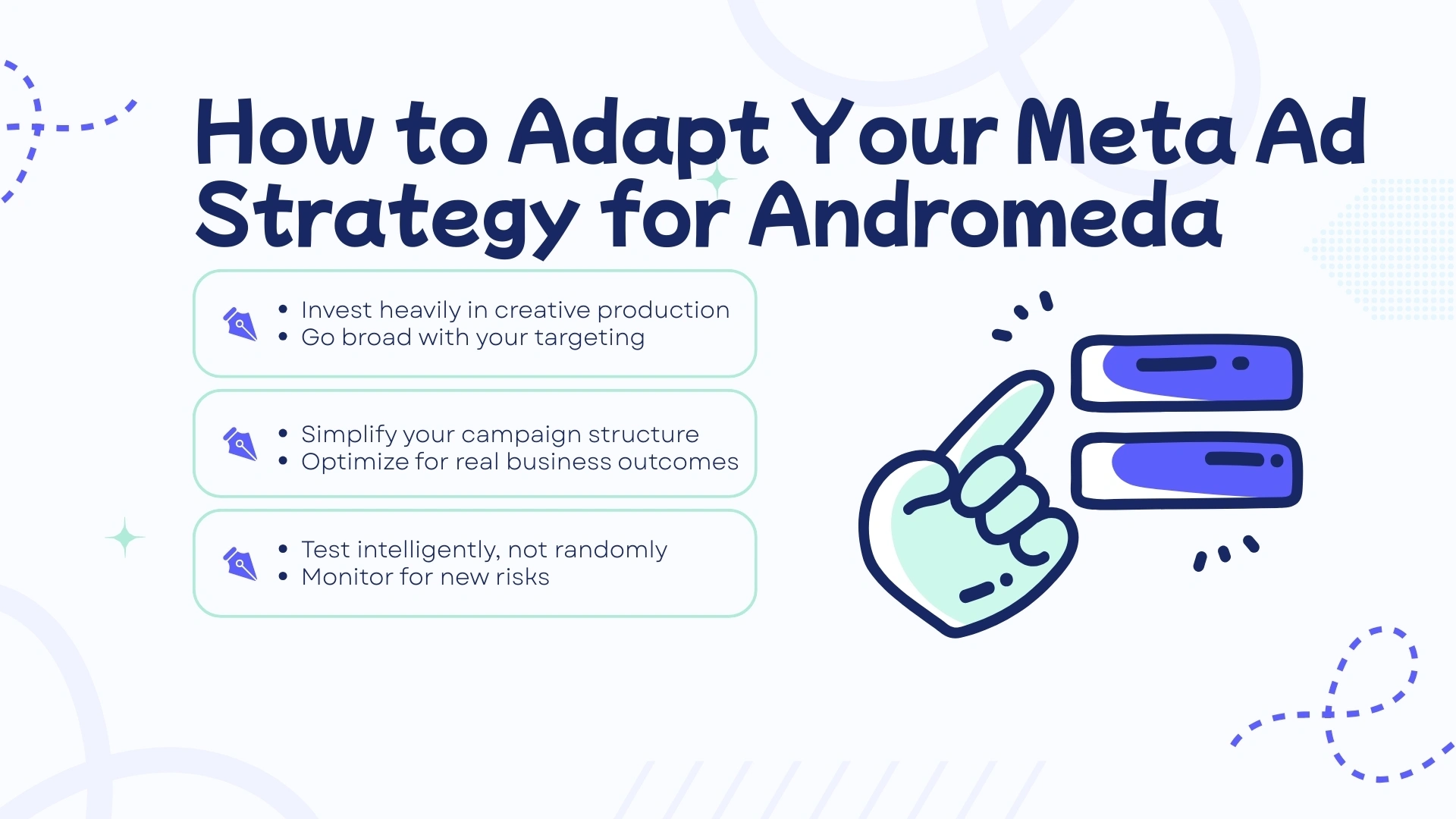
Invest heavily in creative production. The quality and diversity of your ad creative is now your primary competitive advantage. Aim for 10–20 genuinely distinct concepts per campaign, each addressing a different user motivation, problem, or emotional context. Refresh creative weekly or bi-weekly to prevent fatigue and give Andromeda ongoing learning signals.
Go broad with your targeting. Resist the urge to over-segment. Let Meta’s system find the patterns. Use Advantage+ placements and broad audience parameters, and trust the algorithm to optimize delivery based on creative signals rather than manual audience constraints.
Simplify your campaign structure. Consolidate budgets. Use CBO. One campaign per objective. This gives the system the data density it needs to learn efficiently and allocate spend toward what’s working.
Optimize for real business outcomes. Feed Andromeda conversion signals that actually reflect business value — sales, leads, purchases — rather than shallow metrics like clicks or video views. The system learns what to optimize for based on the signals you provide, so make sure those signals point toward meaningful results.
Test intelligently, not randomly. When a creative concept starts winning, treat it as a data source rather than a finished product. Understand why it’s working — is it the visual, the headline, the emotional hook, the CTA? Then test each element independently to extract maximum learning from each winner before scaling.
Monitor for new risks. With AI systems making more autonomous decisions, it’s worth keeping a closer eye on traffic quality. Some advertisers have noted increased exposure to click fraud and low-quality bot traffic as targeting becomes less manual. Investing in proper ad fraud monitoring is a reasonable precaution in this new environment.
Conclusion
The Meta Andromeda update is not a crisis, but it is a crossroads. Advertisers who treat it as just another platform tweak and keep running the same playbook will find themselves falling behind. Those who recognize it as a fundamental shift in how performance advertising works on Meta — and restructure their strategy accordingly — stand to benefit significantly.
The core insight is simple: Meta’s AI now handles the who. Your job is to nail the what. Diverse, high-quality creative that speaks to different motivations and contexts is the primary lever you have left to pull. Pull it well, and Andromeda becomes an advantage rather than an obstacle.
The best advertisers on Meta in 2025 and beyond won’t be the ones who can outsmart the algorithm. They’ll be the ones who feed it best.
Wants to know more visit Blogs.