
Artificial Intelligence has evolved rapidly over the past few years — from basic chatbots to advanced language models. But in early 2025, something genuinely new arrived that shifted the conversation entirely. If you’ve been following tech news and wondering what is Manus AI, you’re not alone. This revolutionary technology took the internet by storm, and for good reason. In this blog, we break down everything you need to know about it: where it came from, how it works, what makes it different, and why it matters.
What Is Manus AI? A Simple Definition
So, what is Manus AI, exactly? At its core, Manus AI is a general-purpose, fully autonomous artificial intelligence agent developed by the Chinese startup Butterfly Effect (also known as Monica.im). The name “Manus” comes from the Latin word for “hand,” symbolizing its ability to not just think — but actually do. It was officially launched on March 6, 2025, and quickly became one of the most talked-about AI developments of the year.
Unlike traditional AI tools that respond to prompts and wait for your next instruction, Manus AI independently plans, executes, and delivers the results of complex, multi-step tasks — all with minimal human supervision. Think of it less like a chatbot and more like a tireless digital colleague working away in the background while you focus on other things.
The Origins of Manus AI
What is Manus AI’s backstory? The product was built by Butterfly Effect, a startup whose previous product was an AI assistant called Monica. The company is headquartered in Singapore (to comply with international data regulations), though much of its development happened in Wuhan, China. The key figure behind the project is Xiao Hong, who previously founded Nightingale Technology and built enterprise productivity tools.
The launch of Manus AI generated an enormous buzz — some compared it to the DeepSeek moment earlier in 2025, when another Chinese AI tool shocked the global tech community with its unexpected capabilities. Influential voices in tech, including Twitter co-founder Jack Dorsey, praised its performance. In December 2025, Meta announced plans to acquire the company for a reported $2–3 billion, with Manus continuing to operate independently post-acquisition.
How Does the Manus AI Work?
To truly understand what is Manus AI, you need to look under the hood. Rather than relying on a single large language model, What is Manus AI uses a sophisticated multi-agent architecture made up of three specialized sub-agents working together:
- The Planner Agent — This acts as the strategist. When you give Manus a high-level goal, the Planner breaks it into a series of manageable, logical sub-tasks.
- The Execution Agent — This is the action module. It carries out the steps: browsing the web, writing and running code, filling forms, interacting with APIs, and more.
- The Verification Agent — This reviews and quality-checks the results before delivering them to you.
This team-like internal structure allows Manus AI to handle complex workflows that would overwhelm a conventional AI assistant. All of this happens inside a cloud-based computing environment — meaning Manus can continue working even after you’ve closed your browser or stepped away from your desk.
The system draws on powerful underlying models, including Anthropic’s Claude 3.5 Sonnet and fine-tuned versions of Alibaba’s open-source Qwen models. This combination gives it both broad reasoning capability and strong execution power.
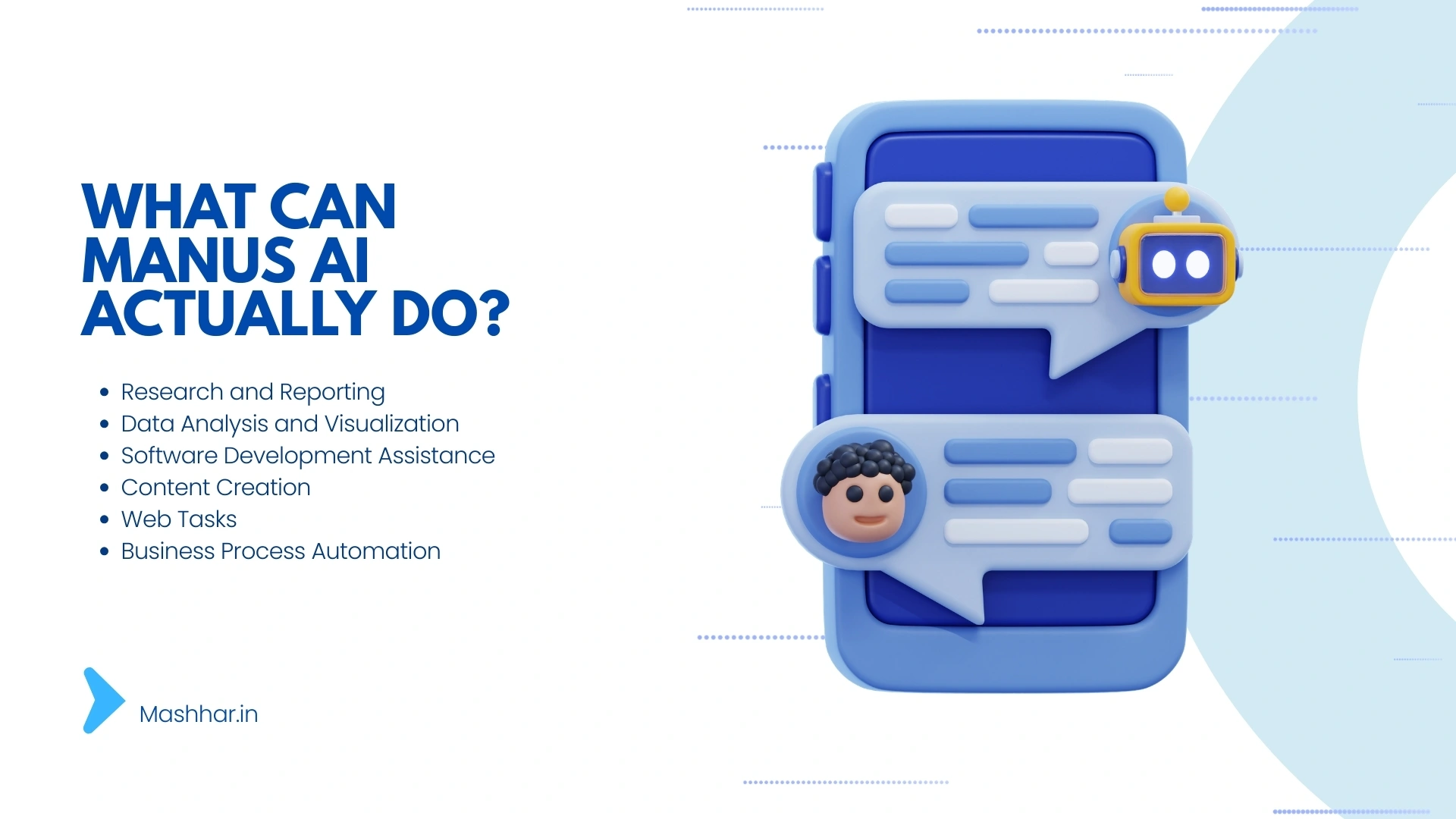
What Can Manus AI Actually Do?
Once you understand what is Manus AI from a technical perspective, the next logical question is: what does it actually accomplish in the real world?
The answer is: quite a lot. Here are some of the tasks Manus AI can handle autonomously:
- Research and Reporting — Give it a topic, and Manus will browse the web, gather information, synthesize findings, and deliver a polished written report.
- Data Analysis and Visualization — It can process spreadsheets, identify trends, and generate visual summaries without you writing a single line of code.
- Software Development Assistance — Manus can write, test, and even deploy code, making it valuable for developers and non-developers alike.
- Content Creation — From drafting blog posts to creating structured presentations, Manus handles end-to-end content workflows.
- Web Tasks — It can search listings, fill out forms, book appointments, and interact with web-based tools on your behalf.
- Business Process Automation — Customer support ticket routing, HR workflow management, financial report generation — Manus can handle recurring enterprise tasks with minimal setup.
A distinctive feature is the “Manus’s Computer” window, which lets users observe exactly what the agent is doing in real time — and intervene at any point if needed. This transparency is a major differentiator from other autonomous AI systems.
How Does Manus AI Compare to Other AI Tools?
When asking what is Manus AI in the broader AI landscape, it helps to compare it against familiar tools.
Vs. ChatGPT or Claude: Traditional chatbots are designed for conversational interaction — they respond to prompts, provide text-based answers, and wait for your next message. Manus AI goes several steps further by executing real-world actions, not just generating suggestions.
Vs. OpenAI’s Deep Research: While Deep Research is a step toward autonomous information gathering, Manus AI operates across a wider range of tasks and doesn’t just stop at research — it takes action.
Vs. Other Agentic AI Platforms: Enterprise platforms like SmythOS prioritize governance and structured control. Manus AI leans more heavily into raw autonomy, which is both its greatest strength and one of its current limitations.
In benchmark testing, what is Manus AI achieved state-of-the-art (SOTA) performance on the GAIA benchmark — a rigorous test of real-world AI problem-solving — outperforming OpenAI’s GPT-4 with plugins across all three difficulty levels. For reference, humans score around 92% on GAIA; GPT-4 with plugins scores around 15%.
The Significance of Manus AI for Industries
Now that we’ve covered what is Manus AI and what it can do, why does it matter at a larger scale?
The implications are wide-reaching. Industries ranging from healthcare to finance to manufacturing stand to benefit from a tool that can autonomously handle complex, multi-step processes. In healthcare, it could assist with research summarization and clinical documentation. In finance, it could automate reporting, compliance checks, and data reconciliation. In software development, it can serve as a tireless coding companion that works through the night.
Analysts from firms like ABI Research and Gartner have projected that agentic AI — the category Manus AI represents — could drive a trillion-dollar industry by 2030. Manus AI is one of the earliest and most capable examples of this trend made real.
Limitations and Challenges
No honest discussion of what is Manus AI would be complete without addressing its current limitations.
As of its launch, Manus AI was in a closed beta phase requiring an invitation code. The pricing model, ranging from approximately $39 to $200 per month, reflects the significant computational resources it consumes. Users have also reported occasional reliability issues — like making incorrect assumptions, cutting corners on complex tasks, or running into context-window limitations on very long workflows.
There are also broader concerns around data privacy, regulatory compliance, and the ethical dimensions of deploying highly autonomous AI systems in high-stakes industries. Following Meta’s proposed acquisition of the company, Chinese regulatory authorities launched an initial review to examine whether Manus AI’s technology falls under national security or export regulations — adding further complexity to its global rollout.
The Future of Manus AI
So where is Manus AI headed? With Meta’s backing, the platform is positioned to scale rapidly. Meta has said it intends to integrate Manus AI’s technology into its own suite of products, including Meta AI, while allowing Manus to continue operating independently through its own app and website.
Strategic partnerships — including one with Alibaba Cloud and the Qwen AI model team — have already expanded Manus AI’s capabilities and infrastructure. These collaborations point toward a future where Manus becomes even faster, more reliable, and more deeply integrated into enterprise workflows.
As AI agents become mainstream, what is Manus AI today may represent just the beginning. The shift from AI as a conversational tool to AI as an autonomous executor of real-world tasks is one of the most significant transitions in the history of the technology.
Final Thoughts
If there’s one takeaway from this deep dive into what is Manus AI, it’s this: we are entering a genuinely new phase of artificial intelligence. What is Manus AI if not a preview of what’s coming — a world where AI doesn’t just advise but actually acts, doesn’t just suggest but truly delivers?
Whether you’re a business owner looking to automate processes, a developer wanting a powerful coding companion, or simply a curious observer watching AI evolve, Manus AI is worth understanding. It represents a bold step toward the autonomous AI future that researchers and visionaries have long discussed — and it’s here now, not somewhere off on the horizon.
More importantly, Manus AI signals a shift in how humans will collaborate with technology. Instead of spending hours managing tools, analyzing data, or coordinating digital workflows, users may soon rely on AI systems that can independently plan, execute, and optimize tasks. This transformation could reshape industries, increase productivity, and open new opportunities for innovation. As AI continues to mature, tools like Manus AI will likely become essential digital partners in everyday work and decision-making. Understanding it today prepares us for a future where intelligent systems play a far more active role in how we create, build, and solve problems.
Visit For More Blogs