
Email marketing remains one of the most powerful tools in a digital marketer’s arsenal. Despite the rise of social media, short-form video, and AI-driven advertising, the humble email continues to deliver results that most other channels simply can’t match. If you’re a business owner, marketer, or entrepreneur looking to grow your audience and revenue, understanding email marketing isn’t optional — it’s essential.
In this guide, we’ll cover everything you need to know: what email marketing is, why it works, how to build your list, craft compelling campaigns, choose the right tools, and measure success.
What Is Email Marketing?
Email marketing is the practice of sending targeted messages to a group of subscribers via email, with the goal of building relationships, nurturing leads, and driving sales or other desired actions. It’s one of the oldest forms of digital marketing — and one of the most effective.
Unlike social media posts that disappear in a feed or ads that get ignored, an email lands directly in someone’s inbox. That’s personal territory. When someone gives you their email address, they’re inviting you in. That invitation, when respected and used wisely, becomes one of the most valuable assets your business can have.
Why Email Marketing Still Works in 2026
The numbers speak for themselves. Email marketing consistently delivers an average return on investment of $36 to $42 for every $1 spent, making it the highest-ROI channel in digital marketing. There are over 4.5 billion email users worldwide, and that number continues to grow every year.
But beyond the statistics, email works for a few deeper reasons.
You own your list. If Instagram shuts down tomorrow or Google changes its algorithm overnight, your social following or search traffic can vanish instantly. Your email list, however, belongs to you. No platform can take it away.
Email is intentional. People check email with purpose. They’re not mindlessly scrolling — they’re actively looking through their inbox. A well-timed, relevant email gets read.
Segmentation and personalization are unmatched. No other marketing channel lets you slice your audience into such precise segments and deliver highly tailored content at scale. You can send one message to first-time buyers, another to loyal customers, and a completely different one to people who abandoned their cart — all automatically.
Building Your Email List the Right Way
In Email Marketing, your email list is the foundation of every campaign you’ll ever run. Without a quality list, even the best-written email goes nowhere.
The keyword here is quality. A list of 500 engaged subscribers who genuinely want to hear from you will always outperform a list of 5,000 cold contacts who never asked to receive your emails.
Use lead magnets. A lead magnet is something of value that you offer in exchange for someone’s email address. This could be a free ebook, a discount code, a checklist, a mini-course, a template, or exclusive access to content. The stronger and more relevant your lead magnet is to your target audience, the faster your list will grow.
Optimize your sign-up forms. Place opt-in forms in high-traffic areas of your website — your homepage, blog posts, exit popups, and landing pages. Keep the form simple: ask only for what you need, usually a name and email address. The fewer fields, the higher the conversion rate.
Never buy email lists. Purchased lists are filled with uninterested contacts, invalid addresses, and potential spam traps. They damage your sender reputation, harm your deliverability, and can get your account banned by email service providers. Always grow your list organically.
Types of Email Marketing Campaigns
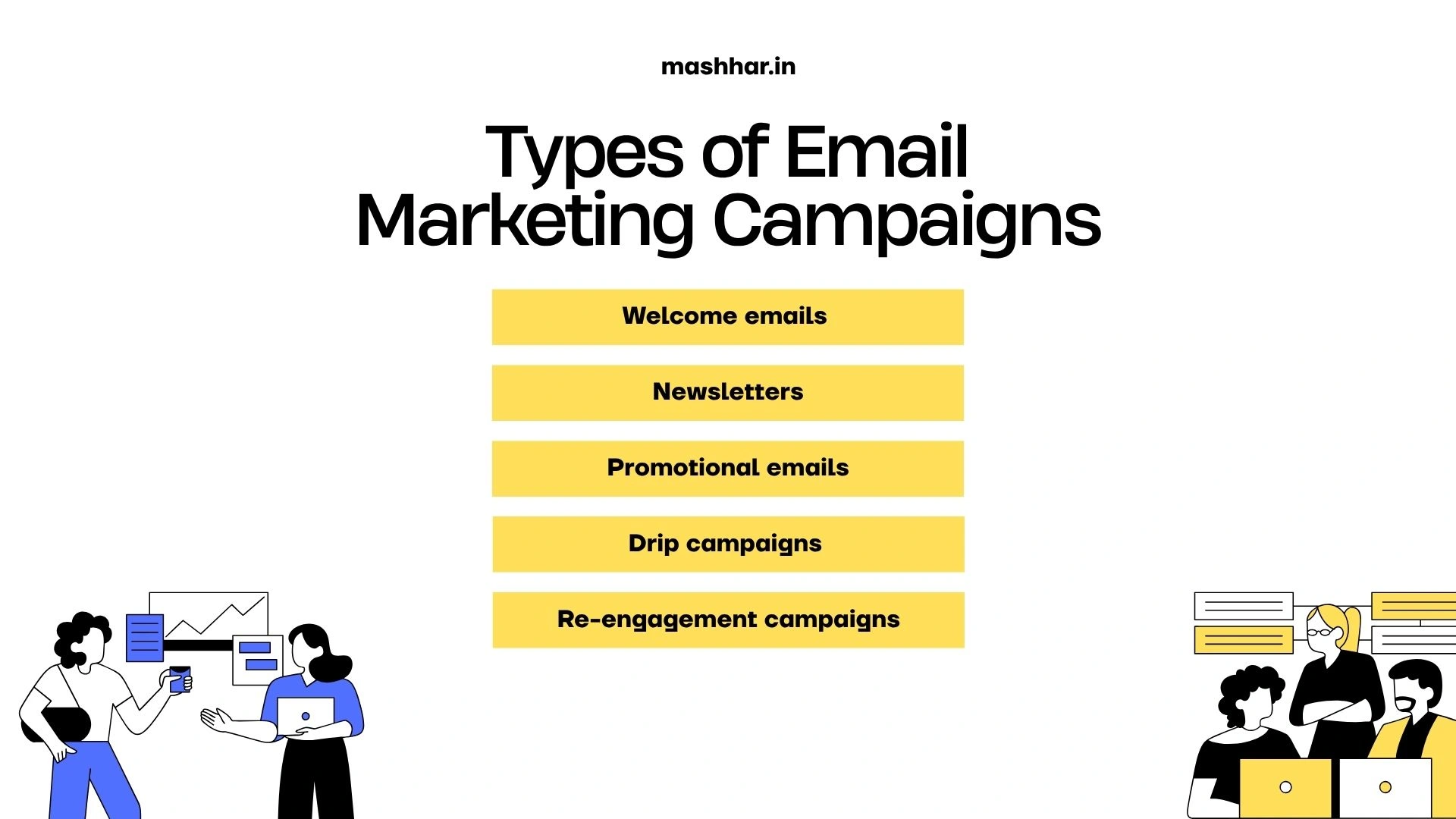
Not all marketing emails are the same. Understanding the different types helps you build a more strategic and effective email program.
Welcome emails are sent automatically when someone joins your list. They set the tone for the relationship, introduce your brand, and often have the highest open rates of any email you’ll ever send. Don’t waste this moment — make it count.
Newsletters are regular updates sent to your entire list or specific segments. They keep your audience informed, provide ongoing value, and maintain top-of-mind awareness. The best newsletters feel like a letter from a trusted friend, not a corporate announcement.
Promotional emails are campaign-driven messages focused on driving a specific action — a sale, a product launch, an event registration. They tend to be more direct and sales-oriented, but they work best when they’re sent to an audience that’s already been warmed up with valuable content.
Drip campaigns (also called automated sequences or nurture sequences) are a series of pre-written emails sent at scheduled intervals after a trigger event, such as signing up to a list or downloading a resource. They guide a prospect through a journey — from awareness to consideration to purchase — without you having to lift a finger each time.
Re-engagement campaigns are sent to subscribers who have gone quiet. Instead of letting them silently drift away, a well-crafted re-engagement email gives them a reason to reconnect — or cleanly removes them from your list if they’re no longer interested.
Creating Emails That Readers Will Actually Open
You can have a massive list and a brilliant strategy, but if your emails don’t get opened, none of it matters. Copywriting is at the heart of effective email marketing.
Become proficient with the subject line.
The gatekeeper is your subject line. It decides whether or not your email is read. Make it seem intimate, spark curiosity, and be succinct (less than 50 characters is ideal for mobile). Avoid using trigger words for spam, such as “FREE!!!” or “Act Now” to send your email to the junk mail folder.
Write for one person. Even if you’re sending to 10,000 subscribers, write as if you’re speaking to one individual. Use “you” frequently. Refer to the reader’s specific situation, goals, or pain points. This creates an intimate tone that builds trust.
Lead with value, not with yourself. Nobody wants to read an email that starts with “At XYZ Company, we believe…” They want to know what’s in it for them. Open with a hook — a bold statement, a surprising fact, a relatable problem — and then deliver value.
Have one clear call to action. Every email should have one primary goal. Don’t ask readers to follow you on social media, visit your blog, check out your new product, and reply to your question all in the same email. Pick one CTA and build your entire email around it.
Segmentation and Personalization: The Game Changers
In Email Marketing, sending the same email to everyone on your list is leaving serious money on the table. Segmentation — dividing your list into smaller groups based on specific criteria — allows you to send more relevant, targeted messages that resonate far more deeply.
You can segment your audience by demographics (age, location, gender), behavior (pages visited, products purchased, emails clicked), engagement level (active vs. inactive subscribers), purchase history, or where they are in your sales funnel.
Personalization takes segmentation further. Beyond just inserting someone’s first name in the subject line, true personalization means sending content that reflects each subscriber’s individual interests, behavior, and stage in their journey with your brand. When done well, personalized emails feel less like marketing and more like a service.
The Best Email Marketing Tools in 2026
One of the biggest advantages of email marketing today is that you don’t need a technical background or a large team to run professional campaigns. A wide range of powerful platforms exist to help businesses of all sizes design, automate, and analyze their email efforts with ease.
Mailchimp is one of the most widely recognized email marketing platforms in the world and a natural starting point for beginners. It offers a drag-and-drop email builder, audience segmentation, basic automation, and a free plan for smaller lists. Its intuitive interface and extensive template library make it easy to launch campaigns quickly. In 2026, Mailchimp continues to expand its AI-powered content suggestions and predictive analytics features, making it smarter than ever.
Omnisend is built specifically for ecommerce businesses and stands out for its multichannel capabilities. In addition to email marketing, it enables you to integrate email, SMS, and push notifications into cohesive automated workflows. Features like product pickers, scratch cards, and pre-built ecommerce automations (cart abandonment, order confirmation, browse abandonment) make it a top choice for online store owners looking to drive more revenue with less manual effort.
Klaviyo has become the go-to platform for serious ecommerce marketers, particularly those running on Shopify or WooCommerce. Its deep integration with store data allows for incredibly granular segmentation and personalization — you can target customers based on predicted lifetime value, purchase frequency, browsing behavior, and more. Klaviyo’s automation flows are among the most powerful available, and its analytics dashboard gives marketers a clear picture of exactly how much revenue each campaign and flow generates.
ActiveCampaign is ideal for businesses that want to combine email marketing with a full customer relationship management (CRM) system. It excels at complex automation, lead scoring, and sales pipeline management, making it especially popular with B2B companies and service-based businesses. If your email strategy involves long nurture sequences and multi-step customer journeys, ActiveCampaign gives you the tools to build them precisely.
ConvertKit (now rebranded as Kit) is a favorite among content creators, bloggers, coaches, and independent educators. Its tag-based subscriber system makes managing a growing audience intuitive, and its landing page and form builders are clean and conversion-focused. For creators who want simplicity without sacrificing power, Kit hits a sweet spot.
Brevo (formerly Sendinblue) is a cost-effective option that offers email marketing, SMS campaigns, live chat, and CRM features under one roof. It’s particularly attractive for small businesses and startups because it charges based on the number of emails sent rather than the size of your list, which can result in significant savings at scale.
GetResponse rounds out the list as a versatile all-in-one platform covering email marketing, landing pages, webinar hosting, and conversion funnels. It’s a solid choice for businesses that want multiple marketing tools consolidated into a single subscription.
Choosing the right tool ultimately depends on your business type, budget, technical comfort level, and how sophisticated your automation needs are. Most platforms offer free trials or free tiers, so it’s worth testing a couple before committing.
Measuring Email Marketing Success
You can’t improve what you don’t measure. The key metrics every email marketer should track are open rate, click-through rate (CTR), conversion rate, bounce rate, and unsubscribe rate.
Your open rate tells you how compelling your subject lines are. Industry averages hover around 20–30%, though this varies by sector. Your click-through rate measures how many people clicked a link in your email — this reflects the effectiveness of your content and CTA. Your conversion rate is the ultimate metric: how many subscribers took the desired action, whether that’s making a purchase, signing up for a webinar, or filling out a form.
Monitor your bounce rate to ensure your list stays clean and healthy. High bounce rates signal deliverability problems. Track your unsubscribe rate to get feedback on whether your content is hitting the mark — a sudden spike often means a campaign missed the audience’s expectations.
Test constantly. A/B test your subject lines, send times, email length, CTA button copy, and even the “from” name. Each test teaches you something about your audience.
Best Practices to Follow
Always comply with email regulations like GDPR, CAN-SPAM, and CASL. Include a clear unsubscribe link in every email. Honor opt-out requests promptly. Never mislead subscribers about what they’re signing up for.
Send consistently, but don’t over-send. Find a cadence that keeps you top of mind without causing fatigue. For most businesses, one to three emails per week is a reasonable range, but the right frequency depends on your audience and the value of what you’re sending.
Keep your list clean by regularly removing inactive subscribers who haven’t engaged in six months or more. A smaller, engaged list is always more valuable — and more deliverable — than a bloated one full of disengaged contacts.
Final Thoughts
Email marketing in 2026, when done with intention and care, remains one of the most direct, personal, and profitable ways to grow a business. With platforms like Mailchimp, Omnisend, Klaviyo, ActiveCampaign, Kit, Brevo, and GetResponse making it easier than ever to launch, automate, and optimize campaigns, there’s genuinely no reason for any business to leave this channel untapped.
In email marketing, it’s not about blasting promotions into inboxes — it’s about building genuine relationships with people who want to hear from you, delivering consistent value, and guiding them naturally toward decisions that benefit both them and your business.
Start with a quality list, pick the right tool for your needs, send emails that matter, measure everything, and keep improving. That’s the formula that has made email marketing the cornerstone of digital strategy for decades — and in 2026, it’s stronger than ever.
For More Blogs, Click Here